
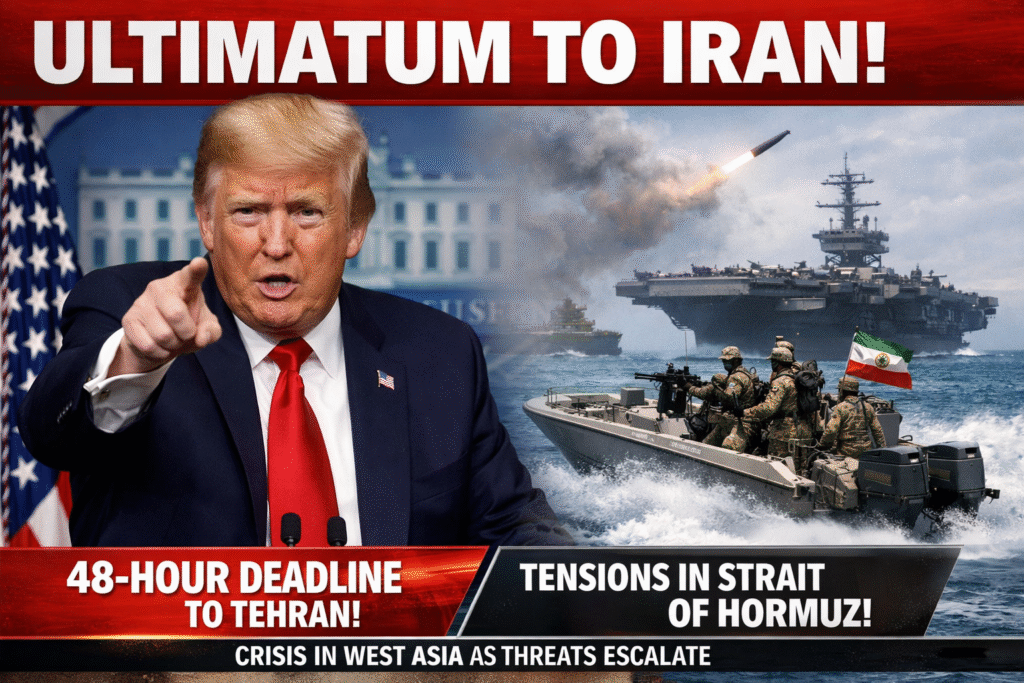
Tensions in West Asia have sharply escalated after former US President Donald Trump issued a strong warning to Iran, demanding that it reopen the Strait of Hormuz within 48 hours or face severe military consequences. His statement has added fuel to an already volatile situation involving Iran, Israel, and the United States, raising fears of a wider regional conflict.
The Strait of Hormuz is one of the most important oil routes in the world. Nearly 20% of global oil supply passes through this narrow waterway. Since late February, Iran has effectively blocked or restricted the movement of many commercial ships through the strait, disrupting global energy markets and pushing oil prices higher.
Trump’s Warning and Rising Pressure
In his latest statement, Trump said that if Iran does not reopen the Strait of Hormuz quickly, the United States will take direct action. He warned that US forces could “hit and obliterate” Iran’s power plants, signaling a possible large-scale military strike.
This statement marks a major shift in tone. Just a day earlier, Trump had hinted at reducing tensions and “winding down” the conflict. However, the latest warning suggests a more aggressive approach, possibly aimed at forcing Iran to back down quickly.
The US believes that Iran’s control over the Strait of Hormuz is a direct threat to global trade and energy security. Blocking the route not only affects oil exports from Gulf countries but also impacts economies worldwide, including major importers like India and China.
Iran Responds with Strong Warning
Iran has responded firmly to Trump’s ultimatum. Iranian military officials warned that any attack by the United States would lead to immediate retaliation. They stated that Iran would target key US infrastructure across West Asia, including energy facilities, IT systems, and desalination plants.
Iran’s leadership has made it clear that it will not accept threats and is ready to defend its territory and interests. The country has also accused the US and Israel of starting the conflict with earlier strikes on its nuclear facilities.
Iranian President Masoud Pezeshkian called for an immediate end to what he described as “US-Israeli aggression.” He also proposed creating a regional security system that does not depend on foreign powers, suggesting that countries in West Asia should work together to maintain peace.
Missile Strikes and Escalation
The situation became more dangerous after Iran launched missile attacks on southern Israel. The strikes reportedly hit areas near the Dimona nuclear facility, causing injuries to over 100 people in cities like Dimona and Arad.
Iranian state media described these attacks as retaliation for earlier strikes carried out by the US and Israel on the Natanz uranium enrichment facility. Natanz is a key part of Iran’s nuclear program and has been targeted multiple times in the past.
Israel has long accused Iran of trying to develop nuclear weapons, which Iran denies. Tehran maintains that its nuclear program is only for peaceful and civilian purposes, such as energy production.
Concerns Over Nuclear Safety
The attack on the Natanz facility has raised serious concerns globally. Rafael Grossi, head of the United Nations nuclear watchdog, urged all sides to show restraint. He warned that continued military action near nuclear sites could lead to a dangerous accident.
A nuclear incident in the region would not only affect West Asia but could have global consequences, including environmental damage and health risks.
US and Military Developments
The US military, particularly the Central Command, has claimed that Iran’s ability to threaten shipping in the Strait of Hormuz has been reduced due to recent operations. However, Iran’s continued actions suggest that the situation is far from under control.
American forces in the region are on high alert, and additional naval and air units may be deployed if tensions continue to rise. The US has also reaffirmed its support for Israel, stating that it will act to protect its ally’s security.
Global Reaction and Diplomatic Efforts
Many countries have expressed concern over the escalating conflict. A group of 22 nations, including the United Arab Emirates, United Kingdom, France, Germany, and Italy, have condemned Iran’s actions in the Strait of Hormuz.
These countries have called for the immediate reopening of the waterway and stressed the importance of freedom of navigation under international law. They have also offered support to ensure safe passage for commercial ships.
Diplomatic efforts are ongoing to reduce tensions. India has also been actively involved. During a recent phone call, Iran’s President spoke with Prime Minister Narendra Modi, discussing ways to bring peace to the region.
India has a strong interest in stability in West Asia, as it relies heavily on oil imports from the region. Any disruption in supply can impact fuel prices and economic growth.
Background of the Conflict
The current conflict began on February 28, when the US and Israel launched strikes on Iranian targets. They claimed that Iran’s actions posed a serious threat to Israel’s security.
In response, Iran launched attacks on Israeli cities, US military bases, and other targets in the region. The situation quickly escalated into a broader confrontation involving multiple countries.
At the center of the conflict is Iran’s nuclear program. Israel believes that Iran is close to developing nuclear weapons, which could shift the balance of power in the region. Iran, however, denies these claims and insists that its program is peaceful.
Impact on Global Economy
The blockade of the Strait of Hormuz has already started affecting global markets. Oil prices have risen due to fears of supply disruption. Countries that depend heavily on oil imports, including India, may face higher fuel costs if the situation continues.
Shipping companies are also facing risks, as attacks on vessels and threats in the region have increased insurance costs and delays. This could impact global trade beyond just oil.
What Lies Ahead
The next 48 hours are critical. If Iran does not reopen the Strait of Hormuz, the US may carry out military strikes, which could trigger a larger war in West Asia.
On the other hand, if diplomatic efforts succeed, there may still be a chance to avoid further escalation. However, with both sides taking strong positions, the situation remains highly uncertain.
The world is closely watching developments, hoping for a peaceful resolution. A full-scale conflict in this region would not only affect the countries directly involved but could also have serious global consequences.
also see
- Nifty Prediction Next Week: Global Signals, Crude Oil Moves, and Technical Breakdown of Nifty 50
- India’s Urea Imports from China Hit 3-Year High Amid Rising Fertiliser Demand