


New Delhi, July 24, 2026: Global crude oil prices remained above the $100 per barrel mark on Friday as escalating geopolitical tensions in the Middle East heightened concerns over potential disruptions to global energy supplies. The continued rally in oil prices has increased fears of inflation, pressured equity markets, and raised concerns for major oil-importing nations such as India.

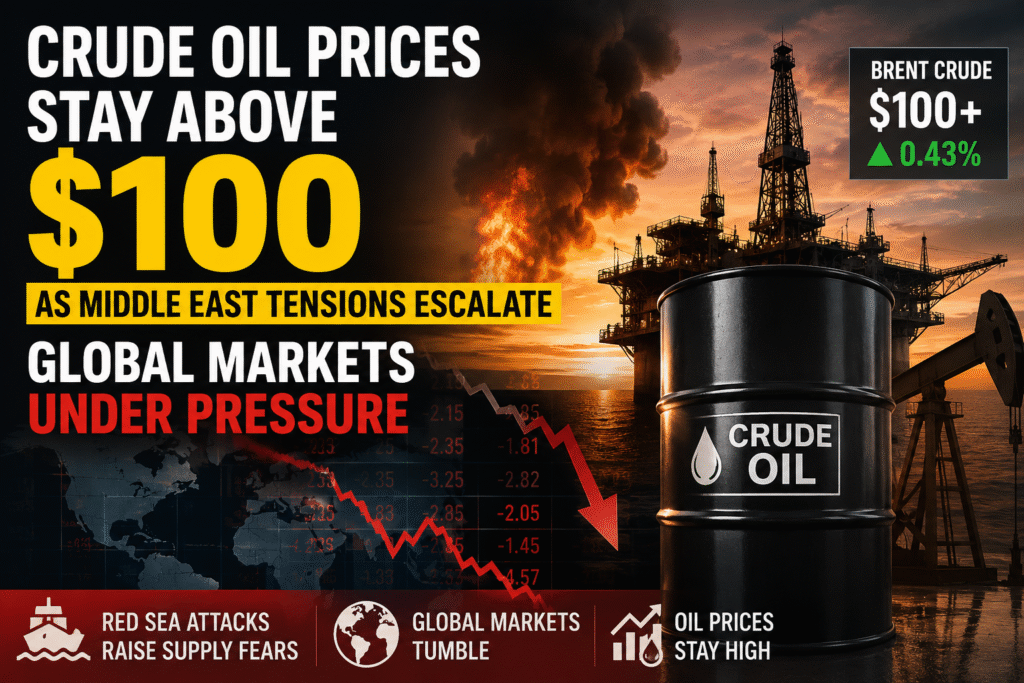

Brent Crude Holds Above $100 Per Barrel
International benchmark Brent crude gained 0.43% (44 cents) to trade above $100 per barrel, while US West Texas Intermediate (WTI) crude rose 0.69% (64 cents) to $92.83 per barrel.
In India, MCX Crude Oil August futures were trading at ₹8,865 per barrel, down ₹159 or 1.76% during morning trade. The decline in MCX prices came despite strength in global benchmarks, reflecting profit booking and currency movements.
Red Sea Attacks Trigger Fresh Supply Concerns
The recent surge in crude oil prices follows attacks by Iran-backed Houthi forces on Saudi oil tankers in the Red Sea, raising fresh concerns about the safety of one of the world’s key shipping routes.
The attacks come alongside continued disruptions in the Strait of Hormuz, another critical corridor through which a significant share of global crude oil exports passes. Any prolonged disruption to these routes could tighten global oil supplies and keep prices elevated.
Market experts believe the attacks have significantly increased the geopolitical risk premium in oil markets, pushing Brent crude back to the $100-per-barrel level.
Middle East Conflict Intensifies
Geopolitical tensions have continued to escalate following the collapse of an interim ceasefire two weeks ago.
According to reports, the United States launched fresh air strikes on Iran, while Iran reportedly responded by firing missiles toward neighbouring Arab countries hosting US military bases. The growing conflict has increased fears of prolonged instability across the Gulf region, which accounts for a major share of global oil production and exports.
Investors are closely monitoring developments, as any further escalation could lead to additional supply disruptions and higher energy prices.
Rising Oil Prices Renew Inflation Concerns
Higher crude oil prices are expected to increase fuel and transportation costs worldwide, potentially delaying the decline in inflation across major economies.
For India, sustained oil prices above $100 per barrel could increase the country’s import bill, widen the current account deficit, put pressure on the Indian rupee, and raise domestic inflation. These factors may also influence future monetary policy decisions and corporate earnings.
Global Equity Markets Under Pressure
The sharp rise in crude oil prices triggered broad-based selling across global equity markets.
Asian markets traded significantly lower:
– Japan’s Nikkei 225 dropped around 3%
– Hong Kong’s Hang Seng Index declined more than 3%
– South Korea’s KOSPI plunged over 5%
US markets also closed lower overnight as investors reacted to the renewed geopolitical risks and the possibility of higher inflation driven by rising energy prices.
The S&P 500 fell 1.21%, while the Nasdaq Composite dropped 2.15%, led by weakness in technology and growth stocks.
Outlook
Oil markets are expected to remain highly volatile as traders closely monitor developments in the Middle East. Any further attacks on energy infrastructure or shipping routes could keep crude oil prices elevated and increase volatility across global financial markets.
For investors, key factors to watch include geopolitical developments, crude oil inventory data, OPEC+ policy decisions, and central bank responses to inflationary pressures. As long as Brent crude remains above $100 per barrel, global markets are likely to remain cautious, with energy prices continuing to dominate investor sentiment.
Also see
Oil Price Forecast: Red Sea Supply Risks Could Push Crude Oil to $120 as Bab el-Mandeb Tensions Rise