
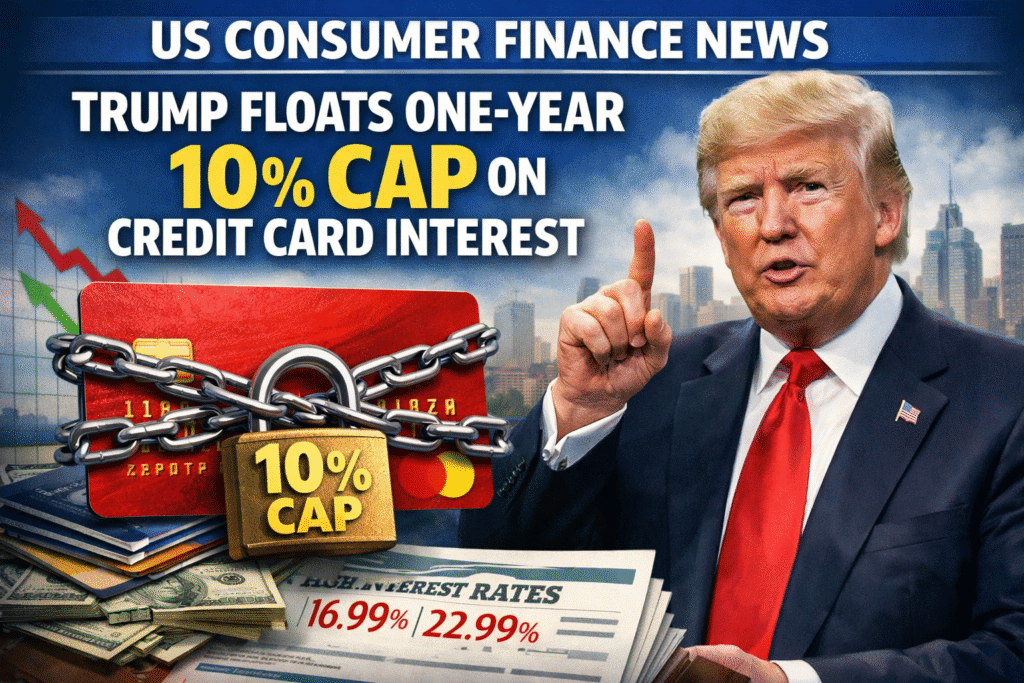
Credit Card Interest Rate News: U.S. President Donald Trump has renewed focus on consumer lending costs by calling for a one-year cap on credit card interest rates at 10%, effective January 20, 2026. The announcement, made on Trump’s social media platform Truth Social, has sparked political debate, with lawmakers questioning how the proposal would be implemented without congressional approval.
Trump’s Announcement and Key Details
In his post, Trump said the proposed cap aims to protect consumers from what he described as unfair practices by credit card companies.
“Effective January 20, 2026, I, as President of the United States, am calling for a one year cap on Credit Card Interest Rates of 10%,” Trump wrote.
However, the president did not provide clarity on the legal mechanism, enforcement process, or whether the cap would be implemented through executive action or legislation.
Political and Legislative Challenges
Analysts and legal experts note that capping credit card interest rates typically requires congressional approval. Although Trump had made a similar pledge during the 2024 election campaign, critics had earlier dismissed it as difficult to execute without new laws.
Currently, Republicans hold a narrow majority in both the U.S. Senate and the House of Representatives, but no specific bill has been formally endorsed by Trump to support the proposed rate cap.
Bipartisan Concern Over High Interest Rates
High credit card interest rates have drawn criticism from both Democratic and Republican lawmakers, reflecting growing bipartisan concern over household debt burdens.
- Senator Bernie Sanders (Democrat) and Senator Josh Hawley (Republican) previously introduced bipartisan legislation to cap credit card interest rates at 10% for five years.
- Representative Alexandria Ocasio-Cortez (Democrat) and Congresswoman Anna Paulina Luna (Republican) have also introduced a House bill seeking a similar 10% cap.
Despite these efforts, none of the proposed bills have yet become law.
Opposition Criticism and Elizabeth Warren’s Response
Democratic lawmakers have criticized Trump for failing to deliver on his campaign promise so far. Senator Elizabeth Warren, a member of the Senate Banking Committee, called the announcement ineffective without legislative backing.
“Begging credit card companies to play nice is a joke. If Trump was serious, he’d work with Congress to pass a bill to cap rates,” Warren said.
Warren also criticized Trump’s previous attempts to weaken the U.S. Consumer Financial Protection Bureau (CFPB), which oversees consumer financial protections.
Banking Industry Reaction
Major U.S. banks and card issuers, including American Express, Capital One, JPMorgan Chase, Citigroup, and Bank of America, have so far declined to comment on the proposal. Industry experts warn that mandatory rate caps could impact lending availability, especially for higher-risk borrowers.
What This Means for Consumers
If implemented, a 10% cap on credit card interest rates could significantly reduce borrowing costs for millions of Americans, particularly as average U.S. credit card APRs remain well above 20%. However, uncertainty over legal authority and enforcement raises questions about whether the proposal will translate into actual policy.
Outlook
Trump’s renewed call has reignited debate around consumer protection, credit card regulation, and household debt relief. While bipartisan support exists in principle, the proposal’s future will depend on Congressional action, regulatory clarity, and cooperation from the financial industry.
also see
- MARKET NEWS
- Insurance Sector News Today: Regulatory Scrutiny, Budget 2026 Hopes, and Tech-Led Growth
- IEX Share Market Coupling Case LIVE: Shares Slide 7% as APTEL Defers Hearing to January 19