
India has taken a major leap in strengthening its strategic defence capabilities with the induction of INS Aridhaman, its third nuclear-powered ballistic missile submarine (SSBN). Commissioned in Visakhapatnam, the submarine marks a significant milestone in India’s journey towards achieving a credible and continuous nuclear deterrence posture.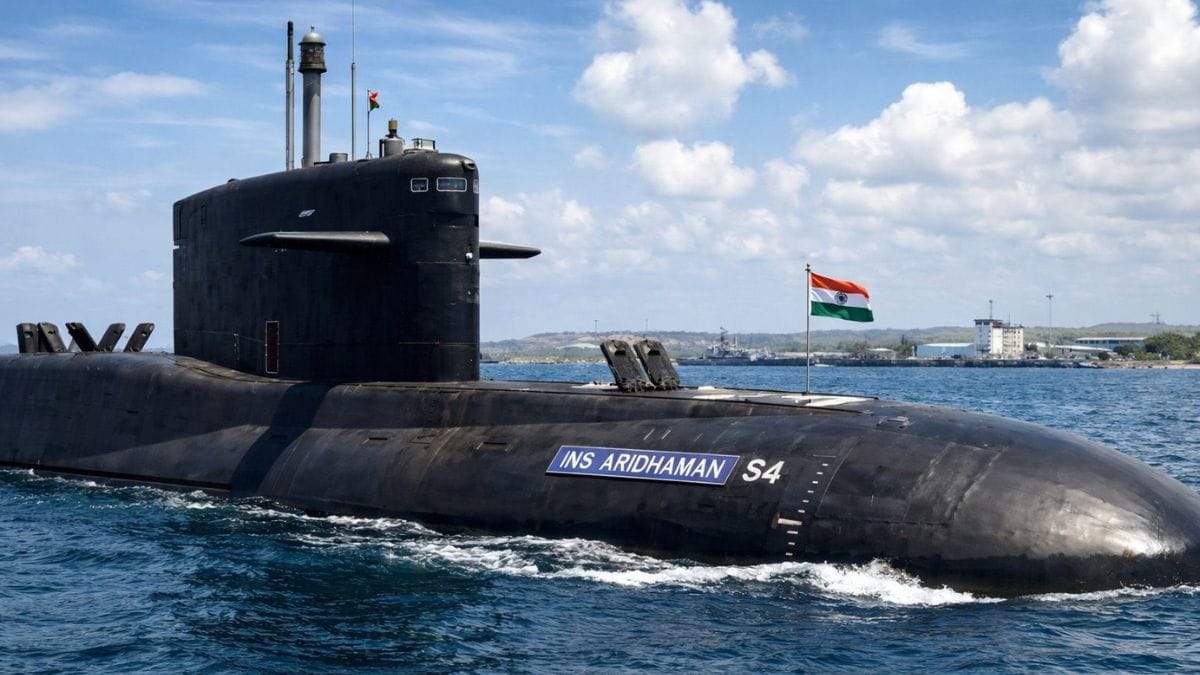
Defence Minister Rajnath Singh described the name “Aridhaman” as more than just a word, calling it a symbol of power and national strength. The commissioning ceremony also saw the induction of the stealth frigate INS Taragiri, reflecting India’s broader push to modernise its naval forces.
INS Aridhaman and the Evolution of India’s Nuclear Triad
The induction of INS Aridhaman completes a crucial phase in India’s nuclear triad — the integration of land, air, and sea-based nuclear delivery systems. With this development, India now joins an elite group of nations capable of maintaining a credible second-strike capability, a key principle of nuclear deterrence.
The submarine joins its predecessors — INS Arihant and INS Arighaat — forming a three-vessel SSBN fleet. This enables, for the first time, a continuous at-sea deterrence (CASD) cycle, where one submarine remains on patrol, another prepares for deployment, and the third undergoes maintenance. This rotation is widely regarded as the global standard for maintaining nuclear readiness.
A Technological Leap in Indigenous Defence
Built under India’s ambitious Advanced Technology Vessel (ATV) programme, INS Aridhaman represents a significant advancement in indigenous defence manufacturing. With approximately 70% local content, the submarine reflects India’s growing self-reliance in critical military technologies.
Weighing around 7,000 tonnes, it is heavier and more advanced than its predecessors. One of its most notable upgrades is its missile capacity — featuring eight vertical launch tubes, double that of earlier submarines in the Arihant-class.
The submarine can carry up to 24 K-15 Sagarika missiles with a range of about 750 km, or eight K-4 missiles capable of striking targets up to 3,500 km away. Powered by an 83 MW nuclear reactor developed by the Bhabha Atomic Research Centre, it can remain submerged for extended periods, making detection extremely difficult.
Strategic Importance of INS Aridhaman
The addition of INS Aridhaman significantly enhances India’s maritime security and deterrence posture, especially in the context of rising regional challenges. With increasing naval activity in the Indo-Pacific, particularly from China, India’s strengthened underwater capabilities provide a crucial strategic advantage.
A nuclear-powered submarine like INS Aridhaman ensures survivability even in the event of a first strike, allowing India to retaliate effectively — a cornerstone of its nuclear doctrine.
Indian Navy’s Expanding Role in National Security
Speaking at the event, Rajnath Singh emphasised that a strong navy is essential for India’s growth as a global power. With over 11,000 km of coastline and nearly 95% of trade dependent on maritime routes, the security of sea lanes has become critical for the nation’s economic stability.
The Indian Navy continues to maintain a strong presence in key regions such as the Persian Gulf and the Malacca Strait, ensuring both national and international maritime security. From disaster relief operations to evacuation missions, the Navy remains at the forefront during crises.
Conclusion: A Silent Guardian Beneath the Seas
The induction of INS Aridhaman is not just a defence upgrade — it is a statement of India’s strategic intent and technological progress. As the silent guardian of the deep, it strengthens India’s deterrence capability while reinforcing its position as a responsible and capable maritime power.
With this milestone, India moves one step closer to securing its future in an increasingly complex global security environment.