
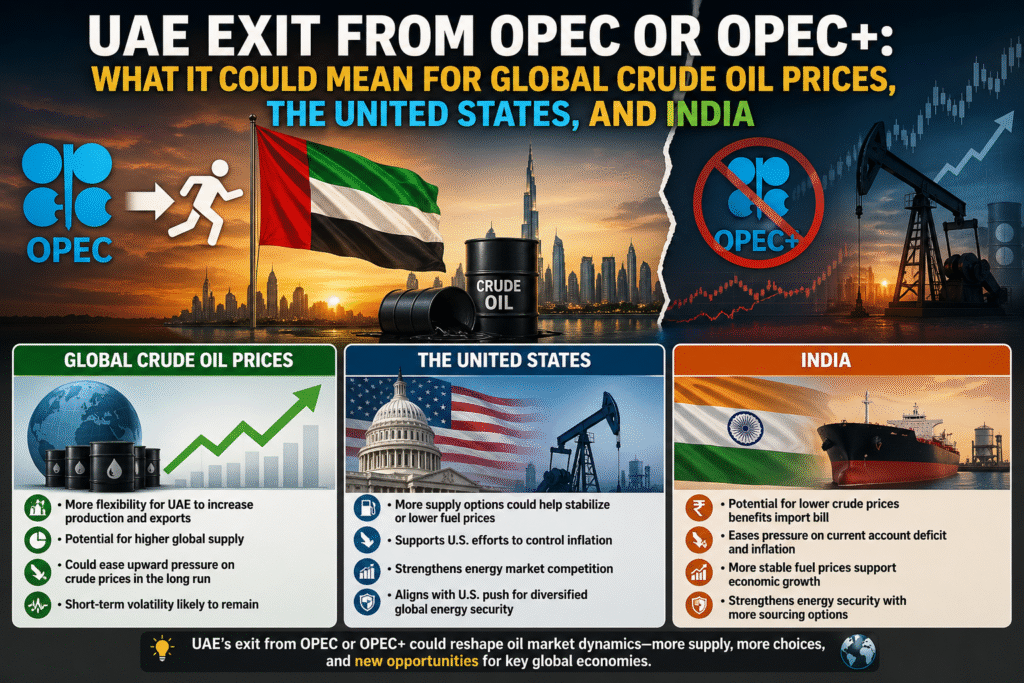
In recent, speculation has periodically surfaced around whether the United Arab Emirates might reconsider its role within the powerful oil-producing alliances of OPEC and OPEC+. While no confirmed exit has occurred as of now, the possibility itself raises significant questions about global oil dynamics. What would happen if the UAE stepped away from OPEC or OPEC+? Would crude oil prices rise or fall? Who benefits—the United States or countries like India? And overall, would it be positive or negative for the global energy market?
This article explores the potential economic, geopolitical, and market implications of such a move in depth.
Understanding OPEC and OPEC+
Before analyzing the impact, it’s important to understand the role of OPEC and OPEC+. OPEC is a group of major oil-exporting countries that coordinate production policies to stabilize oil markets. OPEC+ includes additional producers like Russia, making it an even more influential coalition.
Together, these groups control a significant share of global oil supply. By adjusting production quotas, they can influence crude oil prices—either pushing them higher by cutting supply or lowering them by increasing output.
The UAE is one of the key members, with substantial production capacity and growing ambitions to expand its oil output.
Why Would UAE Consider Leaving?
There are a few strategic reasons why the UAE might consider exiting:
- Production Flexibility
OPEC quotas restrict how much oil member countries can produce. The UAE has invested heavily in expanding its oil capacity and may want to produce more than its assigned quota. - Revenue Maximization
Higher production could mean higher total revenue, even if prices fall slightly. - Strategic Independence
The UAE may want more control over its energy policy rather than aligning with group decisions. - Tensions Within OPEC+
Disagreements over production targets—especially with larger players like Saudi Arabia—could push the UAE toward an independent path.
Impact on Crude Oil Prices
The most immediate and important effect of a UAE exit would be on crude oil prices.
Scenario 1: UAE Increases Production
If the UAE leaves OPEC+ and boosts production significantly:
- Global supply increases
- Oil prices likely fall
- Market competition intensifies
This would resemble a mini “price war,” similar to past conflicts within OPEC+.
Scenario 2: Market Uncertainty
Even if production doesn’t increase drastically, the psychological impact on markets could be strong:
- Traders may fear breakdown of OPEC discipline
- Volatility in benchmark prices like Brent Crude could increase
- Prices may fluctuate sharply in the short term
Scenario 3: Domino Effect
If UAE exits, other countries might reconsider their positions:
- Weakening of OPEC+
- Reduced ability to control prices
- Long-term downward pressure on oil prices
Conclusion for Oil Prices:
Overall, a UAE exit is more likely to push crude oil prices downward or increase volatility, especially if production rises.
Impact on the United States
The effect on the United States is complex because it is both a major oil producer and consumer.
Benefits for the U.S.
- Lower Fuel Prices
If crude oil prices fall, gasoline and diesel prices in the U.S. decrease. This helps consumers and reduces inflation. - Economic Boost
Lower energy costs support industries like transportation and manufacturing. - Strategic Advantage
A weaker OPEC+ reduces the cartel’s ability to control prices, which aligns with U.S. geopolitical interests.
Drawbacks for the U.S.
- Pressure on Shale Producers
U.S. oil production, especially shale, is more expensive. Lower prices can hurt profitability. - Reduced Investment
Energy companies may cut back on drilling and expansion.
Net Impact on the U.S.:
- Short-term: Positive (lower prices, lower inflation)
- Long-term: Mixed (pressure on domestic oil industry)
Impact on India
India is one of the world’s largest oil importers, making it highly sensitive to crude price changes.
Benefits for India
- Lower Import Bill
India imports over 80% of its oil. Lower prices significantly reduce the country’s import costs. - Reduced Inflation
Fuel prices affect transportation and goods. Lower oil prices help control inflation. - Improved Fiscal Balance
Government subsidies and deficits can decrease with cheaper oil. - Economic Growth Boost
Lower energy costs stimulate consumption and industrial growth.
Potential Risks
- Market Volatility
Sudden price swings can create uncertainty in planning. - Currency Pressure (Short-term)
Oil price fluctuations sometimes affect the rupee indirectly.
Net Impact on India:
- Clearly positive overall, especially if oil prices decline sustainably.
Impact on Global Energy Markets
A UAE exit could reshape the entire oil market structure.
Weakening of OPEC+
The biggest risk is loss of coordination:
- Less control over supply
- Reduced ability to stabilize prices
- Increased competition among producers
Rise of Free Market Pricing
Oil prices may become more driven by:
- Demand-supply fundamentals
- Geopolitical tensions
- Speculative trading
Increased Volatility
Without strong coordination:
- Prices may swing more frequently
- Energy markets become less predictable
Geopolitical Implications
The move would not just be economic—it would have geopolitical consequences.
- Shift in Middle East Dynamics
Relations between UAE and Saudi Arabia could be tested. - Stronger Role for Non-OPEC Producers
Countries like the United States and Russia may gain influence. - Energy Security Realignments
Importing countries may diversify sources further.
Is It Good or Bad for Crude Oil Prices?
From a purely price perspective:
- Short-term: Likely negative (prices fall or become volatile)
- Long-term: Depends on whether other OPEC members maintain discipline
For consumers (like India), lower prices are beneficial.
For producers (like U.S. shale companies), it can be challenging.
Final Verdict
If the UAE exits OPEC or OPEC+, the consequences would ripple across global markets:
- Crude Oil Prices: Likely to fall or become unstable
- United States: Short-term gain, long-term mixed impact
- India: Strongly positive due to lower import costs
- Global Market: More competitive but less stable
In essence, such a move would mark a shift from coordinated supply control toward a more fragmented and competitive oil market. While this may benefit oil-importing nations and consumers, it could create uncertainty and pressure for producers worldwide.
Vande Bharat Sleeper Train Announced: Bengaluru to Mumbai Route Confirmed